

LUN
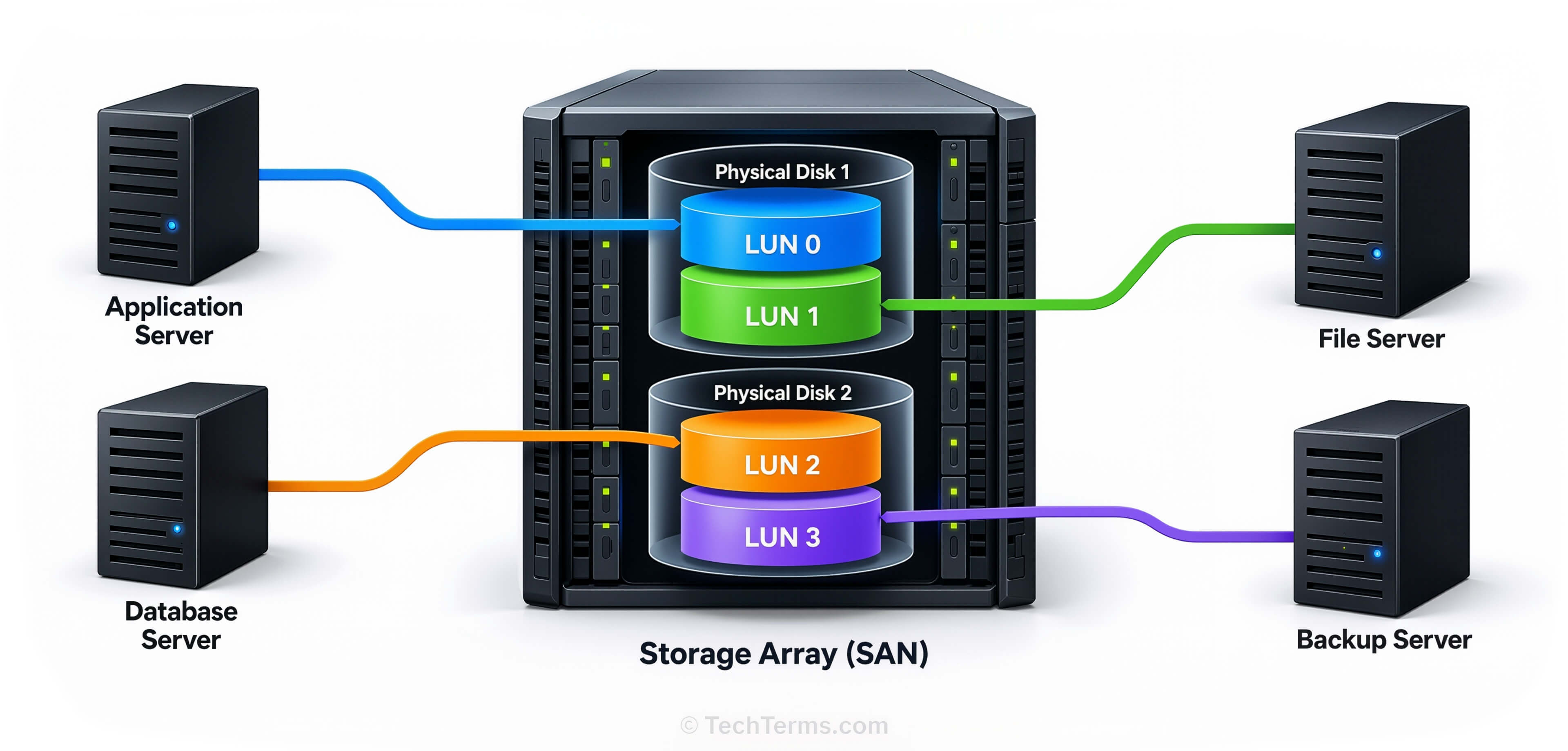
Stands for "Logical Unit Number." A LUN is a unique identifier for a logical storage unit within a storage system. LUNs are commonly used in storage area networks to identify storage volumes that servers can access as separate disks. A single storage array may contain multiple LUNs, allowing several servers or applications to share the same physical storage hardware.
For example, a storage array might provide four separate LUNs for an operating system, database, applications, and backup. Since each LUN represents logical (not physical) storage, each unit may use capacity from one or more physical drives. Servers access these volumes using storage protocols such as Fibre Channel (FCP) or iSCSI, which transfer data between computers and storage devices.
History
LUNs originated with the SCSI interface, which used numerical identifiers to distinguish storage devices connected to the same bus. Early SCSI systems supported a limited number of devices, and LUNs allowed multiple logical units to exist within a single SCSI target. Although modern storage systems are far more flexible, the LUN concept remains widely used in enterprise storage environments.
 Test Your Knowledge